JavaScript 33 – Class Inheritance
Class inheritance allows you to create a new class that inherits properties and methods from an existing class. The new class (subclass/child) can reuse, extend, or override the behavior of the parent class (superclass/base).
A Quick Look at the Example
// Parent class
class Animal {
    constructor(name) {
        this.name = name;
    }

    speak() {
        return `${this.name} makes a sound.`;
    }
}

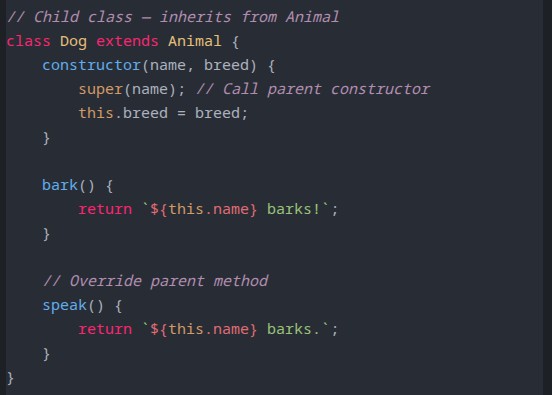
// Child class — inherits from Animal
class Dog extends Animal {
    constructor(name, breed) {
        super(name); // Call parent constructor
        this.breed = breed;
    }

    bark() {
        return `${this.name} barks!`;
    }

    // Override parent method
    speak() {
        return `${this.name} barks.`;
    }
}

const dog = new Dog('Rex', 'Labrador');
console.log(dog.name);   // "Rex" (inherited)
console.log(dog.breed);  // "Labrador" (own)
console.log(dog.speak()); // "Rex barks." (overridden)
console.log(dog.bark());  // "Rex barks!" (own)
a. What is Class Inheritance?
Inheritance is a mechanism where one class (the subclass or child class) acquires the properties and methods of another class (the superclass or parent class).
Key Benefits
| Benefit | Description |
|---|---|
| Code Reuse | Share common logic across related classes |
| Hierarchy | Model real-world “is-a” relationships |
| Extensibility | Add or modify behavior in subclasses |
| Polymorphism | Same method name, different behavior |
The extends Keyword
Use extends to create a subclass:
class Child extends Parent {
    // ...
}
Visual:
        ┌─────────────┐
        │   Animal    │ ← Parent (superclass)
        │  (base)     │
        └──────┬──────┘
               │ extends
       ┌───────┼───────┐
       │       │       │
       ▼       ▼       ▼
   ┌──────┐ ┌──────┐ ┌──────┐
   │ Dog  │ │ Cat  │ │ Bird │ ← Children (subclasses)
   └──────┘ └──────┘ └──────┘
b. The super Keyword
The super keyword is used to access the parent class. It has two forms:
| Usage | Description |
|---|---|
super(args) | Calls the parent constructor |
super.method() | Calls a parent method |
Rule: super() Must Be Called First
In a subclass constructor, you must call super() before using this.
class Dog extends Animal {
    constructor(name, breed) {
        super(name);      // ✅ Must be called first
        this.breed = breed;
    }
}

// ❌ This will throw an error:
class BadDog extends Animal {
    constructor(name, breed) {
        this.breed = breed; // ❌ ReferenceError
        super(name);         // Too late!
    }
}
Why? The parent constructor is responsible for initializing this. Until super() runs, this doesn’t exist.
c. Inheritance Examples
Example 1: Basic Inheritance
class Animal {
    constructor(name) {
        this.name = name;
    }

    speak() {
        return `${this.name} makes a sound.`;
    }
}

class Dog extends Animal {
    // No constructor — uses parent's
}

const dog = new Dog('Rex');
console.log(dog.name);   // "Rex"
console.log(dog.speak()); // "Rex makes a sound."
Note: If the subclass has no constructor, the parent’s constructor is used automatically.
Example 2: Adding New Properties and Methods
class Dog extends Animal {
    constructor(name, breed) {
        super(name);          // Call parent constructor
        this.breed = breed;   // New property
    }

    bark() {
        return `${this.name} barks!`; // New method
    }
}

const dog = new Dog('Rex', 'Labrador');
console.log(dog.name);   // "Rex"
console.log(dog.breed);  // "Labrador"
console.log(dog.speak()); // "Rex makes a sound." (inherited)
console.log(dog.bark());  // "Rex barks!" (own)
Example 3: Overriding Methods
A subclass can override a parent method by redefining it.
class Dog extends Animal {
    constructor(name, breed) {
        super(name);
        this.breed = breed;
    }

    // Override parent's speak()
    speak() {
        return `${this.name} barks.`;
    }
}

const dog = new Dog('Rex', 'Labrador');
console.log(dog.speak()); // "Rex barks." (overridden)
Example 4: Calling Parent Method with super.method()
You can call the parent method from within an overridden method using super.method().
class Dog extends Animal {
    constructor(name) {
        super(name);
    }

    speak() {
        const parentSpeak = super.speak(); // Call parent's speak()
        return `${parentSpeak} Actually, ${this.name} barks.`;
    }
}

const dog = new Dog('Rex');
console.log(dog.speak());
// "Rex makes a sound. Actually, Rex barks."
When to use super.method():
- Extend parent behavior (rather than replacing it)
- Reuse parent logic + add new behavior
- Maintain both parent and child behavior
Example 5: Multi-Level Inheritance
Inheritance can chain across multiple levels.
class Animal {
    constructor(name) {
        this.name = name;
    }
    move() {
        return `${this.name} moves.`;
    }
}

class Mammal extends Animal {
    constructor(name, furColor) {
        super(name);
        this.furColor = furColor;
    }
    feedMilk() {
        return `${this.name} feeds milk.`;
    }
}

class Dog extends Mammal {
    constructor(name, furColor, breed) {
        super(name, furColor);
        this.breed = breed;
    }
    bark() {
        return `${this.name} barks!`;
    }
}

const dog = new Dog('Rex', 'brown', 'Labrador');
console.log(dog.move());     // "Rex moves." (from Animal)
console.log(dog.feedMilk()); // "Rex feeds milk." (from Mammal)
console.log(dog.bark());     // "Rex barks!" (own)
Chain:
Animal → Mammal → DogExample 6: instanceof Checks
The instanceof operator checks if an object is an instance of a class (including inherited classes).
const dog = new Dog('Rex');

console.log(dog instanceof Dog);     // true
console.log(dog instanceof Mammal);  // true
console.log(dog instanceof Animal);  // true
console.log(dog instanceof Object);  // true (everything inherits from Object)
Complete Example
<!DOCTYPE html>
<html lang="en">
<head>
<meta charset="UTF-8">
<meta name="viewport" content="width=device-width, initial-scale=1.0">
<title>Class Inheritance</title>
<style>
body {
font-family: 'Segoe UI', Tahoma, Geneva, Verdana, sans-serif;
max-width: 800px;
margin: 0 auto;
padding: 20px;
background: #f8f9fa;
color: #333;
line-height: 1.6;
}
h1 { color: #007bff; border-bottom: 3px solid #007bff; padding-bottom: 10px; }
h2 { color: #28a745; border-left: 4px solid #28a745; padding-left: 15px; margin-top: 30px; }
.demo-box {
background: white;
padding: 20px;
border-radius: 8px;
box-shadow: 0 2px 10px rgba(0, 0, 0, 0.1);
margin: 15px 0;
}
pre {
background: #1e1e1e;
color: #d4d4d4;
padding: 15px;
border-radius: 8px;
overflow-x: auto;
font-family: 'Courier New', monospace;
font-size: 0.9rem;
line-height: 1.8;
}
.keyword { color: #569cd6; }
.string { color: #ce9178; }
.number { color: #b5cea8; }
.function { color: #dcdcaa; }
.comment { color: #6a9955; }
.boolean { color: #569cd6; }
.class-name { color: #4ec9b0; }
#output {
background: #e9ecef;
padding: 15px;
border-radius: 8px;
margin-top: 15px;
min-height: 40px;
font-family: 'Courier New', monospace;
font-size: 0.85rem;
border-left: 4px solid #007bff;
white-space: pre-wrap;
}
table {
width: 100%;
border-collapse: collapse;
margin: 15px 0;
}
th, td {
padding: 10px;
border: 1px solid #ddd;
text-align: left;
}
th { background: #007bff; color: white; }
tr:nth-child(even) { background: #f8f9fa; }
.btn {
padding: 10px 20px;
background: #007bff;
color: white;
border: none;
border-radius: 6px;
font-size: 1em;
font-weight: bold;
cursor: pointer;
margin: 5px;
transition: all 0.3s;
}
.btn:hover {
background: #0056b3;
transform: translateY(-2px);
}
.btn-success { background: #28a745; }
.btn-success:hover { background: #1e7e34; }
.hierarchy {
font-family: 'Courier New', monospace;
font-size: 0.85rem;
background: #1e1e1e;
color: #d4d4d4;
padding: 20px;
border-radius: 8px;
margin: 15px 0;
white-space: pre;
overflow-x: auto;
line-height: 1.8;
}
.class-display {
font-family: 'Courier New', monospace;
font-size: 1.05em;
background: #f8f9fa;
padding: 15px;
border-radius: 8px;
margin: 10px 0;
border-left: 4px solid #007bff;
white-space: pre-wrap;
line-height: 1.8;
}
</style>
</head>
<body>
<h1>Class Inheritance</h1>
<div class="demo-box">
<h2>1. Basic Inheritance with extends</h2>
<pre>
<span class="keyword">class</span> <span class="class-name">Animal</span> {
<span class="function">constructor</span>(name) {
<span class="keyword">this</span>.name = name;
}
<span class="function">speak</span>() {
<span class="keyword">return</span> <span class="string">`${this.name} makes a sound.`</span>;
}
}
<span class="keyword">class</span> <span class="class-name">Dog</span> <span class="keyword">extends</span> <span class="class-name">Animal</span> {
<span class="function">constructor</span>(name, breed) {
<span class="keyword">super</span>(name); <span class="comment">// Call parent constructor</span>
<span class="keyword">this</span>.breed = breed;
}
<span class="function">bark</span>() {
<span class="keyword">return</span> <span class="string">`${this.name} barks!`</span>;
}
<span class="comment">// Override parent method</span>
<span class="function">speak</span>() {
<span class="keyword">return</span> <span class="string">`${this.name} barks.`</span>;
}
}
</pre>
</div>
<div class="demo-box">
<h2>2. Class Hierarchy</h2>
<div class="hierarchy">
<span style="color: #4ec9b0;">Animal</span> (base class)
├── constructor(name)
└── speak()
│
└── <span style="color: #4ec9b0;">Mammal</span> (extends Animal)
├── constructor(name, furColor)
│ └── super(name)
├── furColor (property)
└── feedMilk()
│
└── <span style="color: #4ec9b0;">Dog</span> (extends Mammal)
├── constructor(name, furColor, breed)
│ └── super(name, furColor)
├── breed (property)
├── bark()
└── speak() ← overridden
</div>
</div>
<div class="demo-box">
<h2>3. The super Keyword</h2>
<table>
<tr>
<th>Usage</th>
<th>Description</th>
<th>Example</th>
</tr>
<tr>
<td><code>super(args)</code></td>
<td>Calls parent constructor</td>
<td><code>super(name)</code></td>
</tr>
<tr>
<td><code>super.method()</code></td>
<td>Calls parent method</td>
<td><code>super.speak()</code></td>
</tr>
<tr>
<td><code>super.property</code></td>
<td>Accesses parent property</td>
<td><code>super.name</code> (rare)</td>
</tr>
</table>
<p><strong>Rule:</strong> In a subclass constructor, <code>super()</code> must be called <strong>before</strong> accessing <code>this</code>.</p>
</div>
<div class="demo-box">
<h2>4. Method Overriding and Extending</h2>
<pre>
<span class="comment">// Override — replace parent method</span>
<span class="keyword">class</span> <span class="class-name">Dog</span> <span class="keyword">extends</span> <span class="class-name">Animal</span> {
<span class="function">speak</span>() {
<span class="keyword">return</span> <span class="string">`${this.name} barks.`</span>; <span class="comment">// Completely replaces parent</span>
}
}
<span class="comment">// Extend — call parent + add behavior</span>
<span class="keyword">class</span> <span class="class-name">Dog2</span> <span class="keyword">extends</span> <span class="class-name">Animal</span> {
<span class="function">speak</span>() {
<span class="keyword">const</span> parentSpeak = <span class="keyword">super</span>.<span class="function">speak</span>();
<span class="keyword">return</span> <span class="string">`${parentSpeak} Actually, ${this.name} barks.`</span>;
}
}
</pre>
</div>
<div class="demo-box">
<h2>5. Interactive: Shape Inheritance</h2>
<div style="margin: 10px 0;">
<button class="btn" onclick="showShapes()">Show All Shapes</button>
<button class="btn btn-success" onclick="addCircle()">Add Circle</button>
<button class="btn btn-success" onclick="addRectangle()">Add Rectangle</button>
<button class="btn" onclick="checkInstances()">Check instanceof</button>
</div>
<div class="class-display" id="shapeDisplay">Click a button to explore inheritance</div>
</div>
<div class="demo-box">
<h2>6. Live Output — All Examples</h2>
<div id="output">Loading...</div>
</div>
<script>
// ============================================
// Class Inheritance — Live Demo
// ============================================
let results = [];
// 1. Basic inheritance
results.push('📌 Basic Inheritance:\n');
class Animal {
constructor(name) {
this.name = name;
}
speak() {
return `${this.name} makes a sound.`;
}
}
class Dog extends Animal {
constructor(name, breed) {
super(name);
this.breed = breed;
}
bark() {
return `${this.name} barks!`;
}
speak() {
return `${this.name} barks.`;
}
}
const dog = new Dog('Rex', 'Labrador');
results.push(' const dog = new Dog("Rex", "Labrador")');
results.push(' dog.name → "' + dog.name + '" (inherited)');
results.push(' dog.breed → "' + dog.breed + '" (own)');
results.push(' dog.speak() → "' + dog.speak() + '" (overridden)');
results.push(' dog.bark() → "' + dog.bark() + '" (own)');
results.push('');
// 2. instanceof checks
results.push('📌 instanceof Checks:\n');
results.push(' dog instanceof Dog → ' + (dog instanceof Dog));
results.push(' dog instanceof Animal → ' + (dog instanceof Animal));
results.push(' dog instanceof Object → ' + (dog instanceof Object));
results.push('');
// 3. super.method() — extending parent
results.push('📌 super.method() — Extending Parent:\n');
class Cat extends Animal {
constructor(name) {
super(name);
}
speak() {
const parentSpeak = super.speak();
return `${parentSpeak} Also, ${this.name} meows.`;
}
}
const cat = new Cat('Whiskers');
results.push(' const cat = new Cat("Whiskers")');
results.push(' cat.speak() → "' + cat.speak() + '"');
results.push(' → Calls parent speak() then adds behavior');
results.push('');
// 4. Multi-level inheritance
results.push('📌 Multi-Level Inheritance:\n');
class Mammal extends Animal {
constructor(name, furColor) {
super(name);
this.furColor = furColor;
}
feedMilk() {
return `${this.name} feeds milk.`;
}
}
class Puppy extends Mammal {
constructor(name, furColor, breed) {
super(name, furColor);
this.breed = breed;
}
whimper() {
return `${this.name} whimpers.`;
}
}
const puppy = new Puppy('Buddy', 'golden', 'Golden Retriever');
results.push(' const puppy = new Puppy("Buddy", "golden", "Golden Retriever")');
results.push(' puppy.name → "' + puppy.name + '" (from Animal)');
results.push(' puppy.furColor → "' + puppy.furColor + '" (from Mammal)');
results.push(' puppy.breed → "' + puppy.breed + '" (own)');
results.push(' puppy.speak() → "' + puppy.speak() + '" (from Animal)');
results.push(' puppy.feedMilk() → "' + puppy.feedMilk() + '" (from Mammal)');
results.push(' puppy.whimper() → "' + puppy.whimper() + '" (own)');
results.push('');
results.push(' Chain: ' + [
puppy instanceof Puppy ? 'Puppy' : null,
puppy instanceof Mammal ? 'Mammal' : null,
puppy instanceof Animal ? 'Animal' : null,
puppy instanceof Object ? 'Object' : null
].filter(Boolean).join(' → '));
results.push('');
// 5. Constructor chaining
results.push('📌 Constructor Chaining:\n');
results.push(' new Puppy("Buddy", "golden", "Golden Retriever")');
results.push(' → Puppy constructor runs');
results.push(' → super("Buddy", "golden") calls Mammal constructor');
results.push(' → super("Buddy") calls Animal constructor');
results.push(' → this.name = "Buddy"');
results.push(' → returns to Mammal: this.furColor = "golden"');
results.push(' → returns to Puppy: this.breed = "Golden Retriever"');
results.push('');
// 6. Overriding vs extending
results.push('📌 Override vs Extend:\n');
results.push(' OVERRIDE (replace completely):');
results.push(' speak() { return "New behavior"; }');
results.push('');
results.push(' EXTEND (call parent + add):');
results.push(' speak() {');
results.push(' return super.speak() + " Extra!";');
results.push(' }');
results.push('');
// 7. Inheritance with methods
results.push('📌 Practical: Shape Hierarchy:\n');
class Shape {
constructor(name) {
this.name = name;
}
area() {
return 0;
}
describe() {
return `${this.name}: area = ${this.area().toFixed(2)}`;
}
}
class Circle extends Shape {
constructor(radius) {
super('Circle');
this.radius = radius;
}
area() {
return Math.PI * this.radius ** 2;
}
}
class Rectangle extends Shape {
constructor(width, height) {
super('Rectangle');
this.width = width;
this.height = height;
}
area() {
return this.width * this.height;
}
}
class Square extends Rectangle {
constructor(side) {
super(side, side);
this.name = 'Square';
}
}
const shapes = [
new Circle(5),
new Rectangle(4, 6),
new Square(3)
];
shapes.forEach(shape => {
results.push(' ' + shape.describe());
});
results.push('');
// 8. Polymorphism
results.push('📌 Polymorphism (Same Method, Different Behavior):\n');
results.push(' All shapes have area() but compute differently:');
shapes.forEach(s => {
results.push(' ' + s.name + '.area() → ' + s.area().toFixed(2));
});
results.push('');
// 9. Employee hierarchy
results.push('📌 Practical: Employee Hierarchy:\n');
class Employee {
constructor(name, salary) {
this.name = name;
this.salary = salary;
}
getRole() {
return 'Employee';
}
describe() {
return `${this.name} — ${this.getRole()} ($${this.salary})`;
}
}
class Manager extends Employee {
constructor(name, salary, department) {
super(name, salary);
this.department = department;
}
getRole() {
return 'Manager';
}
describe() {
return super.describe() + ` — ${this.department} dept.`;
}
}
class Developer extends Employee {
constructor(name, salary, language) {
super(name, salary);
this.language = language;
}
getRole() {
return `Developer (${this.language})`;
}
}
const employees = [
new Employee('Alice', 50000),
new Manager('Bob', 90000, 'Engineering'),
new Developer('Carol', 75000, 'JavaScript')
];
employees.forEach(emp => {
results.push(' ' + emp.describe());
});
results.push('');
// 10. Error handling with inheritance
results.push('📌 Practical: Custom Errors:\n');
class AppError extends Error {
constructor(message, code) {
super(message);
this.name = 'AppError';
this.code = code;
}
}
class ValidationError extends AppError {
constructor(message, field) {
super(message, 'VALIDATION_ERROR');
this.name = 'ValidationError';
this.field = field;
}
}
class NotFoundError extends AppError {
constructor(resource) {
super(`${resource} not found`, 'NOT_FOUND');
this.name = 'NotFoundError';
}
}
const errors = [
new ValidationError('Invalid email', 'email'),
new NotFoundError('User')
];
errors.forEach(err => {
results.push(' ' + err.name + ': ' + err.message + ' (code: ' + err.code + ')');
});
results.push('');
results.push(' Error hierarchy:');
results.push(' ValidationError instanceof Error → ' + (errors[0] instanceof Error));
results.push(' ValidationError instanceof AppError → ' + (errors[0] instanceof AppError));
document.getElementById('output').textContent = results.join('\n');
// ============================================
// Interactive: Shape Inheritance
// ============================================
// Reuse Shape, Circle, Rectangle, Square classes from above
const interactiveShapes = [];
function showShapes() {
const display = document.getElementById('shapeDisplay');
if (interactiveShapes.length === 0) {
display.textContent = 'No shapes yet. Click "Add Circle" or "Add Rectangle".';
return;
}
let text = 'All Shapes:\n';
text += '─────────────────────\n';
interactiveShapes.forEach((s, i) => {
text += `${i + 1}. ${s.describe()}\n`;
});
display.textContent = text;
}
function addCircle() {
const r = Math.floor(Math.random() * 8) + 2;
const circle = new Circle(r);
interactiveShapes.push(circle);
updateShapeDisplay('Added ' + circle.describe());
}
function addRectangle() {
const w = Math.floor(Math.random() * 8) + 2;
const h = Math.floor(Math.random() * 8) + 2;
const rect = new Rectangle(w, h);
interactiveShapes.push(rect);
updateShapeDisplay('Added ' + rect.describe());
}
function updateShapeDisplay(message) {
const display = document.getElementById('shapeDisplay');
let text = message + '\n';
text += '─────────────────────\n';
text += `Total shapes: ${interactiveShapes.length}\n\n`;
interactiveShapes.forEach((s, i) => {
text += `${i + 1}. ${s.describe()}\n`;
});
display.textContent = text;
}
function checkInstances() {
const display = document.getElementById('shapeDisplay');
if (interactiveShapes.length === 0) {
display.textContent = 'Add some shapes first!';
return;
}
const shape = interactiveShapes[interactiveShapes.length - 1];
display.textContent =
`Instanceof checks for "${shape.name}":\n` +
`─────────────────────\n` +
`shape instanceof Circle → ${shape instanceof Circle}\n` +
`shape instanceof Rectangle → ${shape instanceof Rectangle}\n` +
`shape instanceof Square → ${shape instanceof Square}\n` +
`shape instanceof Shape → ${shape instanceof Shape}\n` +
`shape instanceof Object → ${shape instanceof Object}\n` +
`\n` +
`shape.constructor.name → ${shape.constructor.name}`;
}
</script>
</body>
</html>Quick Reference
Inheritance Syntax
| Feature | Syntax | Example |
|---|---|---|
| Extend class | class B extends A { } | class Dog extends Animal { } |
| Call parent constructor | super(args) | super(name) |
| Call parent method | super.method() | super.speak() |
| Check instance | obj instanceof Class | dog instanceof Animal |
Rules of super()
| Rule | Description |
|---|---|
| Must call first | Before using this in subclass constructor |
| Only in subclass | Cannot use super() in a class without extends |
| Only in constructor | super() for constructor; super.method() in any method |
| Only once | Can only call super() once per constructor |
Override vs Extend
| Approach | Behavior | Example |
|---|---|---|
| Override | Replace parent method | speak() { return "New"; } |
| Extend | Call parent + add | speak() { return super.speak() + " more"; } |
instanceof Behavior
const dog = new Dog('Rex');

dog instanceof Dog     // true (own class)
dog instanceof Animal  // true (parent class)
dog instanceof Object  // true (everything inherits from Object)
Best Practices
✅ Do This:
// Call super() first in subclass constructor
class Dog extends Animal {
    constructor(name, breed) {
        super(name);       // ✅ First
        this.breed = breed;
    }
}

// Use super.method() to extend parent behavior
class Dog extends Animal {
    speak() {
        return super.speak() + ' Woof!'; // ✅ Reuse + extend
    }
}

// Check instanceof for type safety
if (animal instanceof Dog) { }

// Use inheritance for "is-a" relationships
class Dog extends Animal { }  // Dog IS-A Animal

// Prefer composition over deep inheritance
class Logger { }              // ✅ Composition
class UserService {
    constructor(logger) { }
}
❌ Don’t Do This:
// Don't access this before super()
class Dog extends Animal {
    constructor(name) {
        this.name = name; // ❌ ReferenceError
        super();
    }
}

// Don't forget super() in subclass with constructor
class Dog extends Animal {
    constructor(name) {
        // Missing super()! ❌ Error
        this.name = name;
    }
}

// Don't over-deep inheritance chains
class A extends B extends C extends D { } // ❌ Hard to maintain

// Don't use inheritance for "has-a" relationships
class Car extends Engine { } // ❌ A car HAS an engine

// Don't shadow private fields
class Dog extends Animal {
    #name; // ❌ Different from parent's #name
}
Common Pitfalls
| Pitfall | Problem | Solution |
|---|---|---|
Missing super() | ReferenceError | Always call super() first |
this before super() | ReferenceError | Call super() before this |
| Deep inheritance | Hard to maintain | Prefer composition |
| Overriding constructors | Forgetting to call parent | Use super() |
| Shadowing methods | Wrong behavior | Use super.method() |
Forgetting extends | super() fails | Add extends |
When to Use Inheritance
| Scenario | Use Inheritance? |
|---|---|
| “Is-a” relationship | ✅ Yes |
| Shared behavior | ✅ Yes |
| Specialized variant | ✅ Yes |
| “Has-a” relationship | ❌ Use composition |
| Shared utility functions | ❌ Use functions |
| 3+ levels deep | ⚠️ Prefer composition |
Real-World Example: Web Components
// Base UI component
class Component {
    constructor(element) {
        this.element = element;
        this.state = {};
    }

    setState(newState) {
        this.state = { ...this.state, ...newState };
        this.render();
    }

    render() {
        // Override in subclasses
    }
}

class Button extends Component {
    constructor(element, label) {
        super(element);
        this.state = { label, disabled: false };
    }

    render() {
        this.element.textContent = this.state.label;
        this.element.disabled = this.state.disabled;
    }

    disable() {
        this.setState({ disabled: true });
    }
}
Pro Tip: Class inheritance is a powerful tool for modeling “is-a” relationships. Use it when:
- A subclass is a more specific version of the parent
- You want to reuse parent behavior
- You need polymorphism (same method, different behavior)
Key rules:
- Use
extendsto inherit - Call
super()first in subclass constructors - Use
super.method()to call parent methods - Use
instanceofto check types - Override to replace behavior; extend to add behavior
But remember: Don’t overuse inheritance! Composition is often better for “has-a” relationships. For 3+ level hierarchies, consider composition or mixins. And for utility functions, use plain functions instead of classes.
Stop using slow, ad-bloated tool sites! 🤮
🔎 Search “KandZ Tools” on Google to use many professional utilities for free.
KandZ.me is the ultimate minimalist hub for:
✅ Finance (Mortgage, Interest, Inflation)
✅ Tech (Base64, JSON, Dev Suite, IP)
✅ Health (BMI, BMR, TDEE)
✅ Productivity (Timer, Workspace, QR)
⚡️ Fast & Private
🔒 No data leaves your device
💎 100% Free
🔗 Use it now: https://tools.kandz.me
🔖 Bookmark it—you’ll need it later!