Skip to content

KandZ - Tuts

  • Operating Systems ▾
    • Linux ▾
      • Distros ▾
        • Fedora
        • Other Distros
        • Ubuntu
      • Gnome 48
      • KDE
      • LFCA - Linux Foundation Certified IT Associate
      • LFCS - Linux Foundation Certified Sysadmin
      • LFCE - Linux Foundation Certified Engineer (Sysadmin + Network Admin)
      • Linux CLI
      • Various
      • Bash Scripting
  • Paths ▾
    • Core Web Stack
    • React & Modern UI Stack
    • Linux Core
  • Programming ▾
    • Frontend (FED) ▾
      • React Ecosystem ▾
        • React
        • React Router
        • TanStack Router
        • TanStack Query (React Query)
        • Zustand
        • Redux Toolkit
      • Angular Ecosystem ▾
        • Angular
      • Vue Ecosystem ▾
        • Vue.js
      • Styling & UI Components ▾
        • Tailwind CSS
    • Languages & Runtimes ▾
      • CSS
      • Dart
      • HTML
      • JavaScript
      • Node.js
      • Rust
      • SQL
      • TypeScript
    • Tools & Build Systems ▾
      • Version Control ▾
        • GitHub
        • Git
        • GitLab
      • Package Managers ▾
        • npm
        • Bun
        • yarn
        • pnpm
      • DevOps & Containers ▾
        • Docker
  • Servers & Self-Hosting ▾
    • Internet ▾
      • Internet Backend - Coming Soon
      • Internet Beginner
      • Internet Frontend - Coming Soon
    • Networking & DNS ▾
      • REST API
  • Tools
  • Windows ▾
    • Windows 11
KandZ - Tuts
AngularBunCSSDartDockerGitGitHubGitLabHTMLJavaScriptNode.jsnpmpnpmReactReact RouterRedux ToolkitRustSQLTailwind CSSTanStack Query (React Query)TanStack RouterTypeScriptVue.jsyarnZustandBash ScriptingFedoraGnome 48KDELFCA - Linux Foundation Certified IT AssociateLFCE - Linux Foundation Certified Engineer (Sysadmin + Network Admin)LFCS - Linux Foundation Certified SysadminLinux CLIOther DistrosUbuntuVariousCore Web StackInternet Backend - Coming SoonInternet BeginnerInternet Frontend - Coming SoonLinux CoreReact & Modern UI StackREST APIToolsWindows 11
  • npm 16 🌐 .npmignore vs .gitignore and files Field
    Programming | npm | Tools & Build Systems

    npm 16 🌐 .npmignore vs .gitignore and files Field

    ByKandZ October 21, 2026October 21, 2026

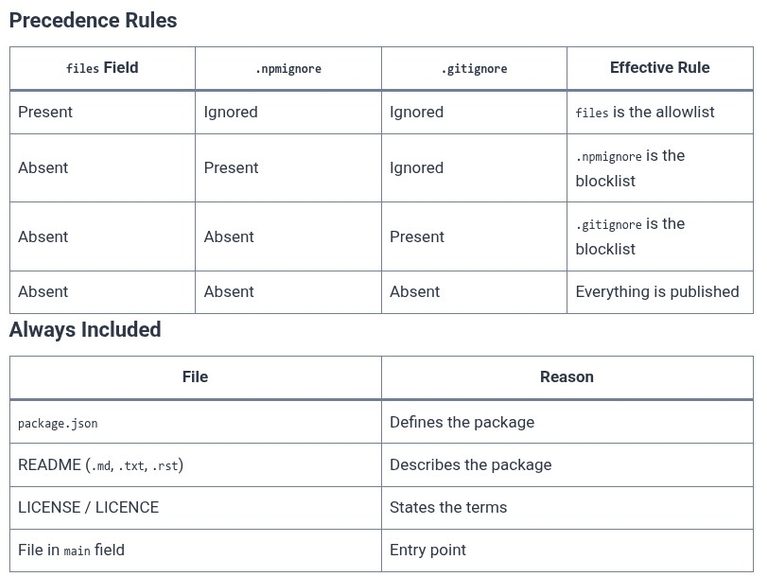
    Publishing a package to the npm registry involves a decision that is easy to get wrong: which files from the project directory end up in the published tarball. Three mechanisms compete for this decision—.gitignore, .npmignore, and the files field in package.json—and their precedence rules are not intuitive. A .gitignore entry that excludes a secrets file…
    Read More npm 16 🌐 .npmignore vs .gitignore and files FieldContinue

  • LFCS 75 🐧 Partitioning with gdisk (GPT)
    Linux | Operating Systems | LFCS - Linux Foundation Certified Sysadmin

    LFCS 75 🐧 Partitioning with gdisk (GPT)

    ByKandZ October 21, 2026October 21, 2026

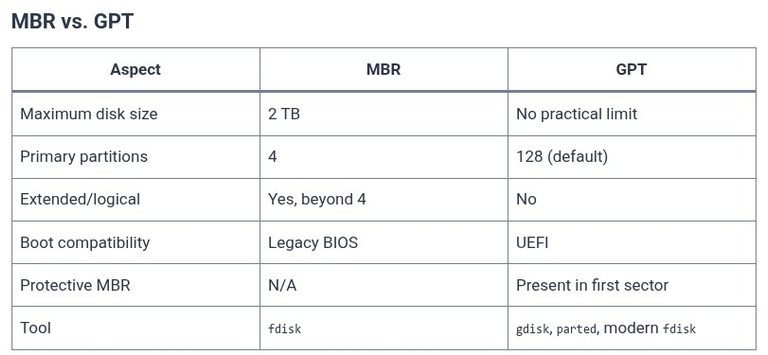
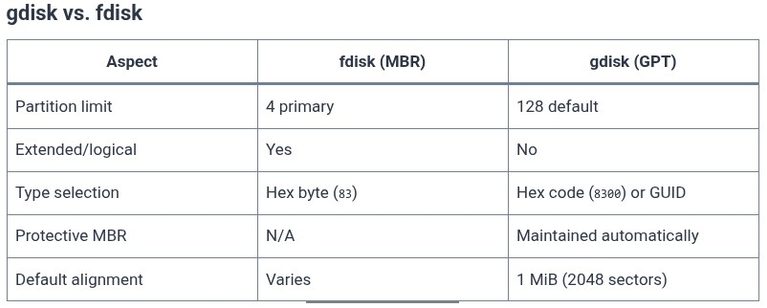
    gdisk is the GPT-aware counterpart to fdisk. It shares the same interactive, menu-driven interface—the same letters for new, delete, type, print, write, and quit—but it operates on GUID Partition Table disks exclusively. Where fdisk asks whether a partition is primary or extended, gdisk does not, because GPT has no such distinction. Every GPT partition is…

    Read More LFCS 75 🐧 Partitioning with gdisk (GPT)Continue

  • LFCS 74 🐧 Partitioning with fdisk
    Linux | Operating Systems | LFCS - Linux Foundation Certified Sysadmin

    LFCS 74 🐧 Partitioning with fdisk

    ByKandZ October 21, 2026October 21, 2026

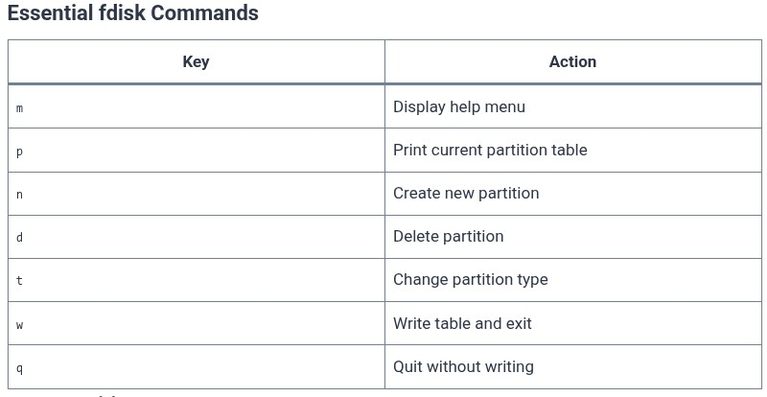
    fdisk is the traditional interactive partition editor for Linux, and it remains the tool the LFCS exam expects you to know for MBR disks. Modern versions of fdisk from util-linux also handle GPT, which means a single tool can inspect and modify both table types, but the menu flow and the partition-numbering rules differ between…

    Read More LFCS 74 🐧 Partitioning with fdiskContinue

  • LFCS 73 🐧 Partitioning — Concepts
    Linux | Operating Systems | LFCS - Linux Foundation Certified Sysadmin

    LFCS 73 🐧 Partitioning — Concepts

    ByKandZ October 21, 2026October 21, 2026

    Partitioning is the act of dividing a physical disk into logical regions that the operating system treats as separate block devices. Every filesystem, swap area, and LVM physical volume begins as a partition or a whole disk. The LFCS objective is not about memorizing the fdisk menu; it is about understanding the two partition table…

    Read More LFCS 73 🐧 Partitioning — ConceptsContinue

  • LFCS 72 🐧 Root Password Reset
    Linux | Operating Systems | LFCS - Linux Foundation Certified Sysadmin

    LFCS 72 🐧 Root Password Reset

    ByKandZ October 21, 2026October 21, 2026

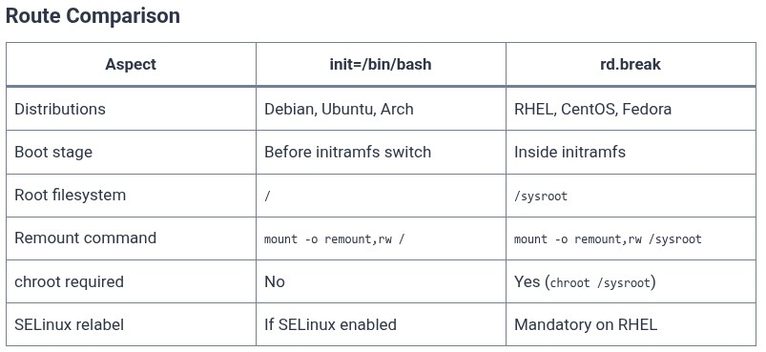
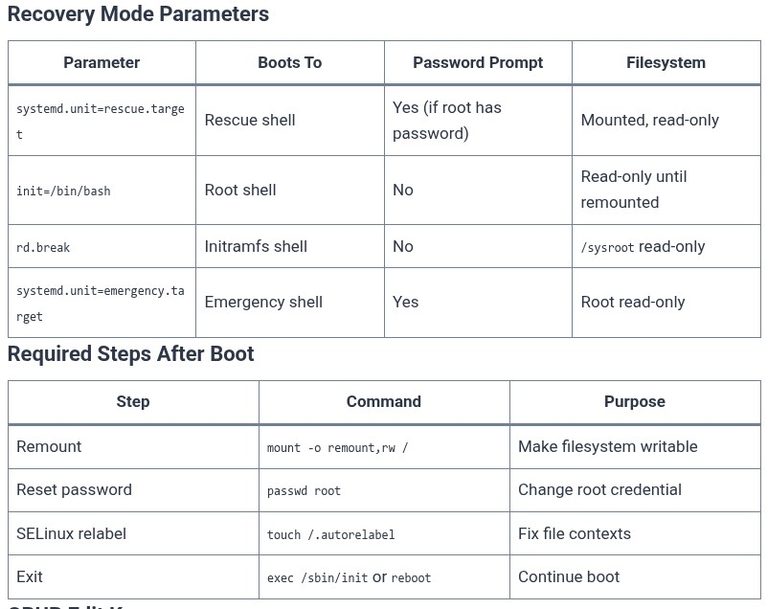
    The root password reset is the most common boot recovery procedure and the one most likely to appear on the LFCS exam as a practical task. The procedure has three stages: interrupt the boot to reach a shell that runs before authentication, remount the filesystem so it can be written, and change the password. The…

    Read More LFCS 72 🐧 Root Password ResetContinue

  • LFCS 71 🐧 Boot Recovery — Single-User Mode
    Linux | Operating Systems | LFCS - Linux Foundation Certified Sysadmin

    LFCS 71 🐧 Boot Recovery — Single-User Mode

    ByKandZ October 21, 2026October 21, 2026

    Single-user mode is the boot state in which the system starts with minimal services and presents a root shell without requiring the normal multi-user login sequence. On systemd systems, the equivalent states are rescue.target (single-user mode, local filesystems mounted, networking stopped) and emergency.target (root mounted read-only, almost nothing else). The distinction matters for recovery: rescue.target…

    Read More LFCS 71 🐧 Boot Recovery — Single-User ModeContinue

  • Vue.js 85 🟢 Deep Reactive Tracking Mechanics (track, trigger, EffectScope)
    Programming | Frontend (FED) | Vue.js

    Vue.js 85 🟢 Deep Reactive Tracking Mechanics (track, trigger, EffectScope)

    ByKandZ October 21, 2026October 21, 2026

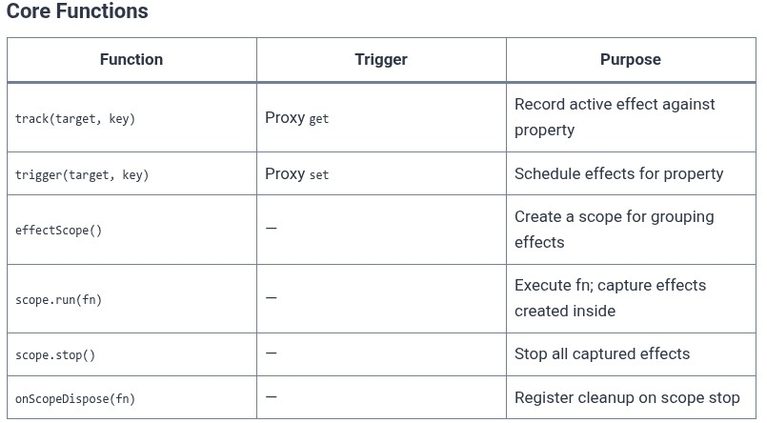
    Vue’s reactivity system is often described as “magic,” but the mechanism is a small set of cooperating functions. A Proxy intercepts property access and calls track to record who is reading. The same Proxy intercepts property writes and calls trigger to notify everyone who was recorded. The EffectScope wraps this machinery in a lifecycle boundary,…

    Read More Vue.js 85 🟢 Deep Reactive Tracking Mechanics (track, trigger, EffectScope)Continue

  • Vue.js 84 🟢 Fine-Grained Reactivity Engine Architecture (Alien Signals & Signal Primitives)
    Programming | Frontend (FED) | Vue.js

    Vue.js 84 🟢 Fine-Grained Reactivity Engine Architecture (Alien Signals & Signal Primitives)

    ByKandZ October 21, 2026October 21, 2026

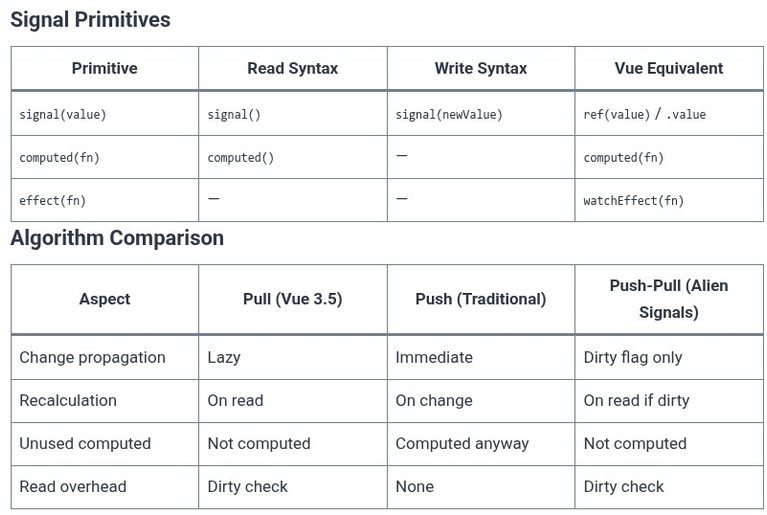
    Vue’s reactivity system is undergoing its most significant architectural change since Vue 3.0. In Vue 3.6, the core dependency-tracking algorithm is being replaced with Alien Signals, a standalone signal library developed by Vue core contributor Johnson Chu . The change is not a surface-level optimization; it is a rewrite of the mechanism that answers the…

    Read More Vue.js 84 🟢 Fine-Grained Reactivity Engine Architecture (Alien Signals & Signal Primitives)Continue

  • Vue.js 83 🟢 Compiler Optimizations: Static Hoisting, Patch Flags, and Tree Flattening
    Programming | Frontend (FED) | Vue.js

    Vue.js 83 🟢 Compiler Optimizations: Static Hoisting, Patch Flags, and Tree Flattening

    ByKandZ October 21, 2026October 21, 2026

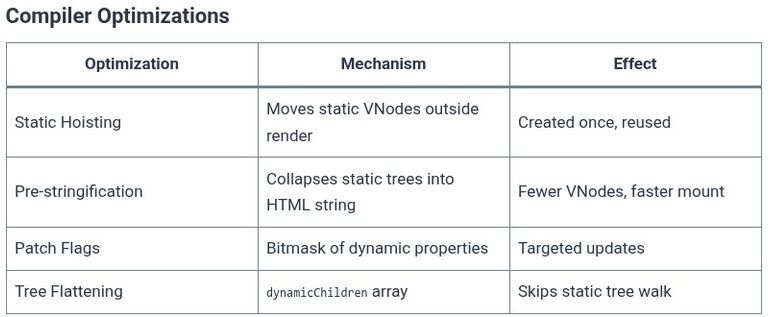
    Vue 3’s performance advantage over Vue 2 comes primarily from the compiler, not from a faster runtime diff algorithm. The compiler analyzes the template at build time and emits metadata that tells the renderer exactly which parts of the tree can change and which cannot. Static Hoisting removes immutable nodes from the render function entirely,…

    Read More Vue.js 83 🟢 Compiler Optimizations: Static Hoisting, Patch Flags, and Tree FlatteningContinue

  • Vue.js 82 🟢 Virtual DOM Architecture, VNode Structure, and Patching Algorithm
    Programming | Frontend (FED) | Vue.js

    Vue.js 82 🟢 Virtual DOM Architecture, VNode Structure, and Patching Algorithm

    ByKandZ October 21, 2026October 21, 2026

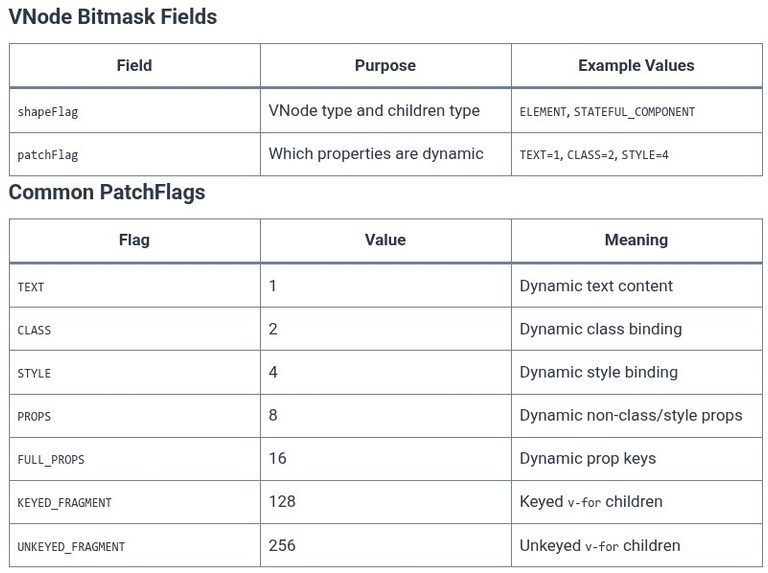
    Vue’s virtual DOM is not a pure runtime diffing engine. It is a hybrid system in which the template compiler and the runtime renderer cooperate. The compiler analyzes the template, identifies which parts are static and which are dynamic, and emits optimization hints that the renderer uses to skip unnecessary work . The VNode—a plain…

    Read More Vue.js 82 🟢 Virtual DOM Architecture, VNode Structure, and Patching AlgorithmContinue

Page navigation

Previous PagePrevious 1 … 44 45 46 47 48 … 258 Next PageNext
    Search